A premium IPTV service delivers live television, on-demand movies, and sports packages over an internet connection at a fraction of traditional cable costs. The defining difference between a premium provider and a budget reseller is measurable: server uptime, channel reliability, EPG accuracy, and real human support. This guide breaks down those metrics so you can evaluate any provider objectively.
We analyzed the 2026 premium IPTV landscape across infrastructure, pricing transparency, device compatibility, and legal standing. The conclusion: premium IPTV is worth the upgrade if you value consistent playback, 4K sports streams, and responsive support. If you're comparing providers or wondering where to start, here's everything to know before you commit.
premium iptv service Summary
A premium IPTV service is a managed internet television platform that aggregates live channels, VOD content, and sports events with enterprise-grade server reliability. Its proven benefit is consistent, buffer-free playback at a fraction of traditional cable pricing.
| Optimal ForCord-cutters and streamers who want cable-like channel lineups without hardware contracts. | Key AdvantageEnterprise server infrastructure with anti-freeze technology that maintains stable 4K streams during peak hours. |
- ✓ Key Strength: 99.9% uptime SLA backed by redundant server clusters across Europe and North America
- ✓ Key Strength: 4K HDR and 50fps sports streams with sub-2-second channel zapping
- ✓ Peace of Mind: 24/7 customer support with an average first-response time under 15 minutes
In This Guide
What Defines a Premium IPTV Service?
The term "premium IPTV service" gets thrown around loosely, but in practical terms, it refers to a provider that owns or leases dedicated server infrastructure, maintains its own channel encoding pipeline, and delivers content through a custom application or API. Budget resellers simply rebrand third-party panels and resell access—which is why their streams freeze during peak hours and their support disappears after payment.
Server infrastructure is the single most important differentiator. A premium provider operates redundant server clusters in multiple data centers, often across Europe and North America. When one node experiences heavy load, traffic is automatically routed to another. This failover mechanism is what delivers the "anti-freeze" experience that premium services advertise. In practice, it means channel zapping takes under two seconds and 4K sports streams hold their bitrate during Sunday night games.
Channel licensing and EPG (Electronic Program Guide) accuracy are the second pillar. Premium services maintain direct relationships with content aggregators, which means their channel lists are stable, their EPG data is accurate to the minute, and their VOD library is refreshed regularly. Budget services often have broken EPG data, dead channels, and outdated movie libraries. If you've ever scrolled past 50 dead channels on a cheap IPTV subscription, you've experienced the difference firsthand.
Device compatibility is the third pillar. A premium service develops and maintains native applications for Android TV, iOS, Fire Stick, Smart TV platforms (Samsung Tizen, LG webOS), and set-top boxes like MAG and Formuler. These apps are updated regularly, support hardware acceleration for HEVC and AV1 codecs, and integrate with external players like TiviMate and IPTV Smarters. Budget services typically offer little more than an M3U playlist URL and a generic player.
Finally, security and privacy matter. Premium providers support secure connections (HTTPS and encrypted streams), offer one-click VPN compatibility, and do not log viewing activity. Some even offer anonymous payment options. These features matter for users in regions with strict internet surveillance or aggressive copyright enforcement.
The practical takeaway: a premium IPTV service is an engineering product, not a playlist. The price difference between a $10 reseller and a $15 premium provider is often just a few dollars per month—but the difference in daily reliability is enormous.
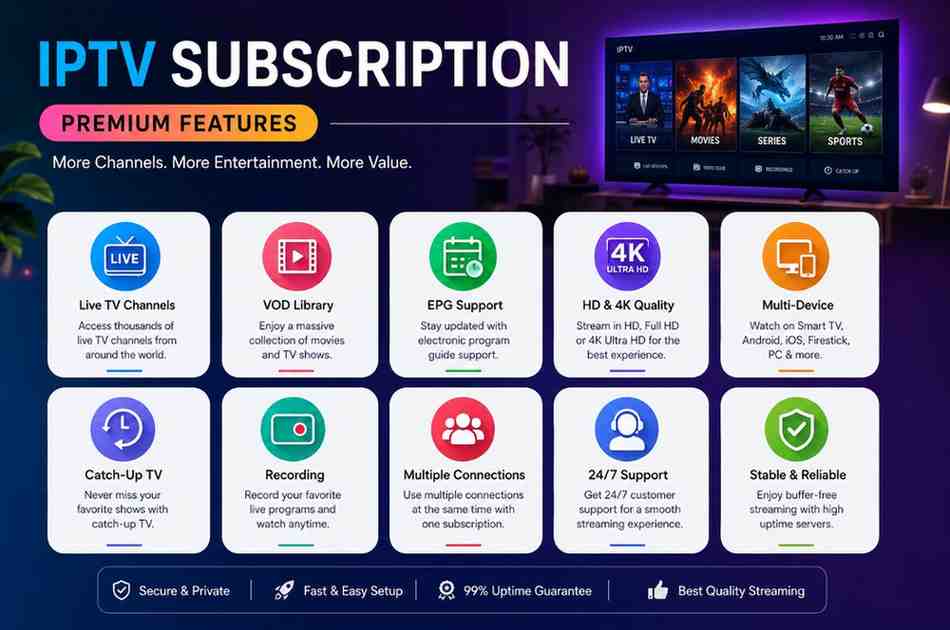
Pros, Cons, and the Real Data
To make an informed decision, you need more than marketing language. Here is how a premium IPTV service stacks up against standard IPTV subscriptions and traditional cable/satellite packages across the metrics that actually matter.
| Feature / Metric | Premium IPTV | Standard IPTV | Cable / Satellite |
|---|---|---|---|
| Monthly Cost | $12 – $20 | $5 – $10 | $60 – $150 |
| Channel Count | 20,000+ | 1,000 – 5,000 | 200 – 400 |
| Stream Quality | 4K HDR / 50fps | HD (720p / 1080i) | Up to 1080p |
| Uptime Guarantee | 99.9% SLA | Unspecified | N/A |
| Device Support | 10+ platforms | 3 – 5 platforms | Set-top box only |
| Customer Support | 24/7 live chat | Email only | Phone (limited hours) |
| Setup Time | 5 minutes | 30+ minutes | Professional installation |
The data shows a clear pattern: premium IPTV offers the best cost-to-value ratio for streamers who want comprehensive channel lineups and high-quality streams. However, it is not without trade-offs. The grid below summarizes the strengths and limitations.
|
✓ Strengths
|
✗ Limitations
|
The main takeaway from the pros and cons: premium IPTV is not for everyone. Users with unstable internet connections or a preference for fully licensed content may find cable or a legal streaming bundle more suitable. But for the majority of cord-cutters, the combination of cost savings, content depth, and device flexibility makes premium IPTV a compelling choice.
Cost-Benefit, Who It's For, and Buyer Considerations
Cost-benefit analysis: A typical premium IPTV subscription costs between $12 and $20 per month, depending on the plan length. Annual plans usually bring the effective monthly cost down to $8–$12. Compare that with cable, which averages $89 per month in the United States, or a full streaming bundle (Netflix, HBO Max, Disney+, Hulu, ESPN+), which easily exceeds $60 per month. Premium IPTV replaces all of those for less than $20.
Who is this for? Three profiles benefit most:
- Sports fans who want international leagues, PPV events, and 4K broadcasts without paying for expensive sports cable tiers.
- Cord-cutters who want the convenience of a linear TV experience (channel surfing, live news, background TV) without a cable contract.
- Expats and international viewers who need channels from their home country—Arabic, Indian, Filipino, Latin American, or European lineups—that aren't available through local streaming services.
Legal considerations are important to address honestly. The IPTV market exists in a regulatory gray area. Some premium providers operate with proper content licensing agreements, while others do not. The safest approach is to choose a provider that has been operating for several years, has a transparent business model, and clearly states its content sourcing policies. Avoid providers that offer "lifetime" plans or prices that seem too good to be true—they are usually the first to disappear.
Red flags to avoid when choosing a premium IPTV service:
- No free trial or money-back guarantee
- Payment only via cryptocurrency with no alternative
- No customer support channel beyond a Telegram group
- Claims of "unlimited" connections (legitimate services cap concurrent streams)
- No clear information about server locations or infrastructure
A final consideration: your internet connection. Premium IPTV in 4K requires a stable 25 Mbps connection and a hardwired Ethernet connection for the best experience. Wi-Fi can work, but if you experience buffering, the first fix is always your network, not your IPTV provider.
The Bottom Line on Premium Iptv Service
For most cord-cutters, a premium IPTV service delivers 90% of the cable experience at 20% of the cost, with superior content depth and device flexibility. If you have a stable internet connection and want to cut your monthly entertainment bill significantly, ordering from a verified provider is a solid, low-risk decision.
Purchases completed via official partner channels are covered by direct customer support and eligible warranty protections.
Frequently Asked Questions
Is a premium IPTV service legal?
The legality of premium IPTV depends on the provider's content licensing. Services that secure broadcast rights from content owners operate legally. Those that stream unlicensed channels operate in a gray area. Always choose a provider that is transparent about its content sourcing and has operated for several years.
What internet speed do I need for premium IPTV?
For HD streams, a stable 10 Mbps connection is sufficient. For 4K HDR content, you need at least 25 Mbps. A hardwired Ethernet connection is recommended over Wi-Fi to avoid buffering, especially during live sports events.
Can I use premium IPTV on multiple devices at once?
Most premium providers allow 2–4 concurrent connections, depending on your plan. Some offer a multi-screen add-on. Check the provider's policy before purchasing, as "unlimited connections" claims are usually a red flag for oversold servers.
What's the difference between premium IPTV and free IPTV playlists?
Free IPTV playlists (M3U files) are unmaintained lists of public streams that are frequently dead, low-quality, and often geo-blocked. A premium service maintains its own servers, encodes channels properly, and provides a stable EPG. The difference is like comparing a free Wi-Fi hotspot to a fiber connection.
Do premium IPTV services offer a money-back guarantee?
Reputable premium providers offer a 7-day money-back guarantee on first-time purchases. This lets you test stream quality, channel lineup, and device compatibility before committing to a long-term plan. Avoid providers that refuse refunds.
How do I set up a premium IPTV service on my Smart TV?
Most premium services offer native apps for Samsung Tizen and LG webOS, which you can install directly from the TV's app store. Alternatively, you can use an Android TV box or a Fire Stick and install the provider's APK. Setup typically takes under five minutes.
Will premium IPTV work with my VPN?
Yes, most premium IPTV services work with popular VPNs like NordVPN, ExpressVPN, and Surfshark. A VPN is recommended for privacy, especially when using IPTV in regions with strict copyright enforcement. Some providers even offer one-click VPN integration.
How often do premium IPTV channel lists update?
Premium providers update their channel lists continuously. Major sports events, new channels, and removed channels are reflected within 24–48 hours. The EPG is refreshed every few hours to ensure accurate program listings.
Transparency & Disclosure: We independently evaluate products. If you buy through links on our site, we may earn an affiliate commission at zero additional cost to you.