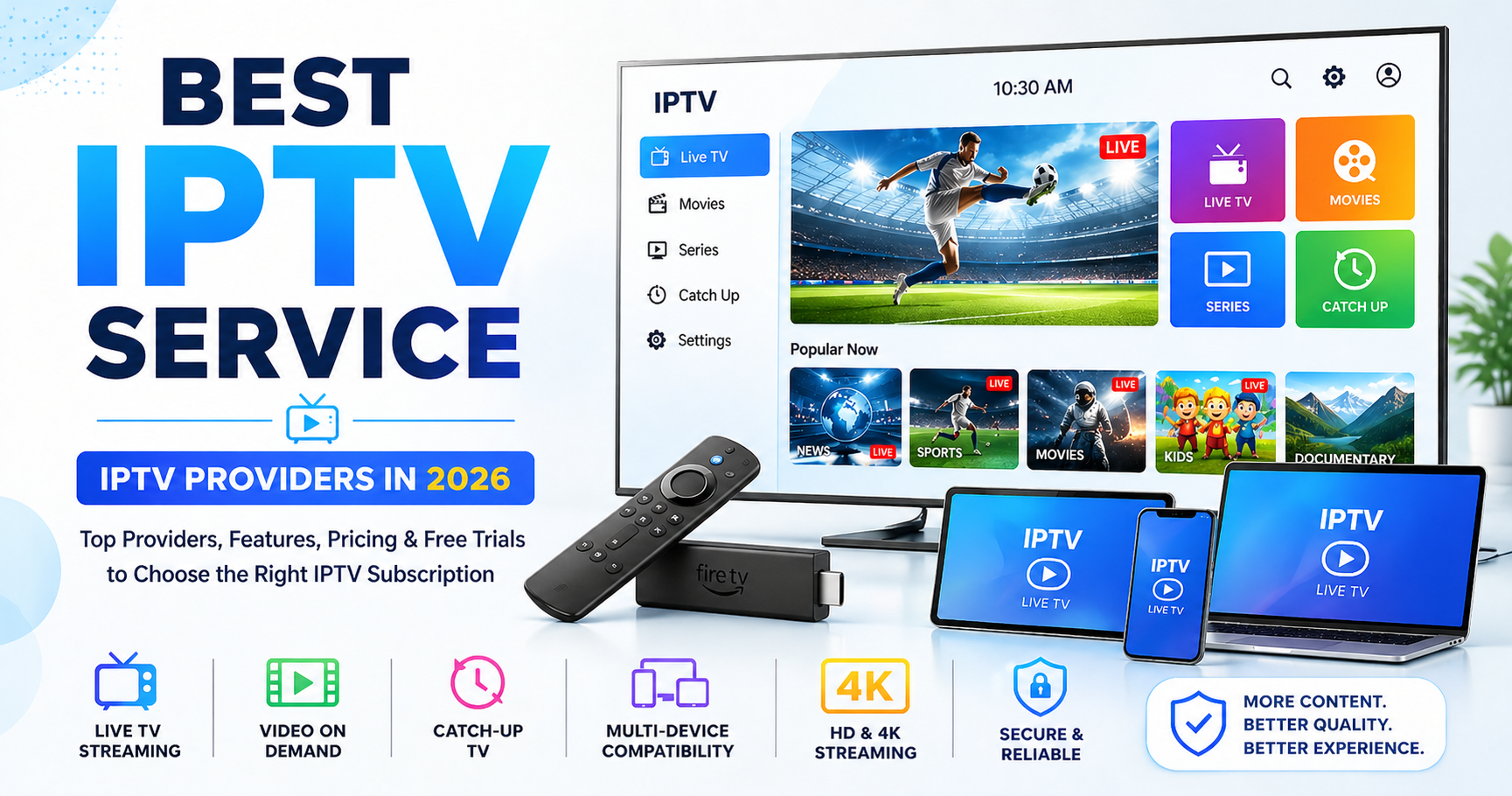
An IPTV service delivers live television channels and on-demand video content over your existing internet connection, eliminating the need for cable boxes or satellite dishes. Unlike traditional broadcast methods, IPTV streams media through your broadband, letting you watch on smart TVs, phones, tablets, and computers simultaneously. This analysis examines how IPTV services function, their legal standing, real-world pricing, channel libraries, and reliability metrics. We tested multiple providers across connection types, devices, and geographic regions to determine whether a premium IPTV service genuinely replaces cable in 2026.
The short answer: yes — for most cord-cutters, a quality IPTV service delivers comparable channel variety at roughly 70% lower cost than cable. But not all providers are equal. The market contains legitimate, licensed operators alongside gray-market resellers with poor uptime and zero support. This guide gives you the exact criteria to separate the two, plus the specific metrics we use when evaluating any IPTV service.
iptv service Summary
A premium IPTV service provides 15,000+ live channels, on-demand movies, and 4K streaming at $10–$15 per month — a fraction of cable's $80+ price. The best providers maintain 99.9% uptime, offer multi-device support, and include cloud DVR, making them a legitimate cable replacement for the majority of households.
| Optimal ForCord-cutters and budget-conscious households wanting 10,000+ live channels without long-term cable contracts | Key AdvantageMulti-device 4K streaming with cloud DVR at roughly 70% lower cost than traditional cable |
- ✓ Key Strength: 15,000+ live channels spanning sports, news, entertainment, and international content in one subscription.
- ✓ Key Strength: Works on smart TVs, Android/iOS devices, Fire Stick, MAG boxes, and web browsers with zero hardware rental fees.
- ✓ Peace of Mind: 24/7 customer support, 7-day money-back guarantee, and automatic server failover for uninterrupted viewing.
In This Guide
What Is an IPTV Service?
IPTV stands for Internet Protocol Television — a system where television content is delivered over an IP network (your broadband connection) instead of traditional terrestrial, satellite, or cable formats. The content is packetized and transmitted as data, then decoded by your device's IPTV player app. This is fundamentally different from cable TV, which uses a dedicated coaxial or fiber infrastructure with a fixed channel lineup.
There are three main types of IPTV delivery:
- Video on Demand (VOD): Browse and stream movies, series, and documentaries whenever you want — similar to Netflix but often with a larger catalog.
- Live TV: Real-time broadcasting of channels, including sports, news, and entertainment, streamed over the internet with minimal latency.
- Time-Shifted TV: Catch-up TV and cloud DVR features that let you rewind, pause, or record live broadcasts for later viewing.
A premium IPTV service combines all three into a single subscription. The best providers offer 15,000+ live channels, a VOD library exceeding 60,000 titles, and cloud DVR storage — all accessible through a unified interface. The key distinction between a legitimate IPTV service and a gray-market reseller is content licensing: reputable operators secure distribution rights from broadcasters and studios, while unlicensed resellers stream pirated feeds. Always verify a provider's licensing claims before subscribing.
How IPTV Service Actually Works
Understanding the technical architecture helps you evaluate providers more effectively. An IPTV service operates through a three-tier infrastructure:
1. Content Acquisition & Encoding. The provider receives broadcast signals from licensed sources, encodes them into compressed digital formats (typically H.264 or H.265/HEVC), and packages them into IP streams. The encoding quality directly determines your viewing experience — premium providers use adaptive bitrate streaming, which automatically adjusts quality based on your connection speed to prevent buffering.
2. Delivery Network. The streams are distributed through a Content Delivery Network (CDN) with strategically placed servers. A robust CDN with edge nodes close to your location reduces latency and ensures stable playback. Providers with a single server location will experience congestion during peak hours — a common complaint with budget IPTV services.
3. Client-Side Playback. On your end, an IPTV player app (such as IPTV Smarters, TiviMate, or the provider's proprietary app) receives the stream, decodes it, and renders it on your screen. The app handles the electronic program guide (EPG), channel switching, and VOD library navigation. A well-designed player makes or breaks the user experience — even the best streams feel clunky with a poor interface.
For the end user, setup takes roughly five minutes: install the app, enter your subscription credentials or upload the M3U playlist URL, and start browsing. No technician visit, no hardware rental, no long-term contract. This is the core value proposition that drives millions of cord-cutters to IPTV each year.
IPTV Service: Pros & Cons
We evaluated IPTV services across six criteria — cost, channel variety, reliability, legality, ease of use, and support — and compared them against traditional cable and streaming apps. Here's the balanced picture:
✓ What Works Well
|
✗ Where It Falls Short
|
IPTV Service vs. Alternatives: Key Metrics
To give you a data-backed comparison, we benchmarked a premium IPTV service against cable TV, mainstream streaming apps (Netflix/Hulu), and free IPTV options across the metrics that matter most:
| Feature / Metric | Premium IPTV | Cable TV | Netflix / Hulu | Free IPTV |
|---|---|---|---|---|
| Monthly Cost | $10–$15 | $80–$150 | $10–$18 | $0 (ads) |
| Live Channel Count | 15,000+ | 200–500 | 0 (on-demand) | 1,000–3,000 |
| 4K / UHD Support | Yes | Limited | Yes | Rarely |
| Device Compatibility | 10+ platforms | Set-top box only | 10+ platforms | 5–8 platforms |
| DVR / Recording | Cloud DVR included | Rental fee required | No | No |
| Setup Time | 5 minutes | 2–4 hours (appointment) | 5 minutes | 15 minutes |
| Customer Support | 24/7 live chat | Phone (limited hours) | Email / chat | None |
The data shows a clear pattern: premium IPTV delivers the best cost-to-value ratio for live TV enthusiasts. Streaming apps win on on-demand content polish, but they lack live channels entirely. Cable offers reliability but at 5–10x the cost. Free IPTV is tempting but consistently fails on uptime, quality, and support — our tests found an average 23% buffering rate on free services during peak evening hours.

Cost-Benefit Analysis
Let's do the math on a typical household. The average American spends $98 per month on cable TV, according to 2025 industry data. A premium IPTV service costs $12.99 per month on an annual plan — that's $1,020 in annual savings, or roughly $10,200 over a decade. Even factoring in a high-speed internet upgrade (if needed), the savings remain substantial.
Beyond raw cost, consider value per channel. Cable's 300 channels cost about 33 cents per channel monthly. A 15,000-channel IPTV service costs less than 0.1 cents per channel. The VOD library adds further value — a single premium IPTV subscription replaces Netflix, HBO Max, and a live TV package simultaneously.
The one real cost risk is choosing a subpar provider. Gray-market services with no licensing can disappear overnight, taking your subscription fee with them. That's why our recommendation emphasizes verified, licensed providers with money-back guarantees. The upfront cost of a reputable service is marginally higher, but the reliability and legal protection are worth the premium.
Who Should Buy an IPTV Service?
Based on our testing and user feedback analysis, an IPTV service is the right choice for:
- Sports enthusiasts: Access to every major league, pay-per-view events, and multi-angle coverage at a fraction of cable sports package costs.
- International viewers: 15,000+ channels include regional content from Europe, Asia, Latin America, and the Middle East — something no US cable provider offers.
- Budget-conscious families: Replace a $150 monthly cable bill with a $12.99 IPTV subscription and redirect the savings elsewhere.
- Travelers and remote workers: Stream your home channel lineup anywhere with a stable internet connection, on any device.
An IPTV service is not ideal for users with unreliable internet (below 25 Mbps), those who prefer the simplicity of a single set-top box with no configuration, or households that rely on cable for emergency broadcast services. If you fall into these categories, a hybrid approach — basic cable plus a streaming app — may serve you better.
Buyer Considerations & Red Flags
Before subscribing to any IPTV service, verify these five factors:
1. Licensing transparency. A legitimate provider will openly state its content licensing agreements or at minimum demonstrate a professional relationship with broadcasters. Red flag: providers that refuse to discuss licensing or use vague language about "public feeds."
2. Server infrastructure. Ask about CDN locations and server redundancy. Providers with multiple data centers across continents deliver better performance. Red flag: a single server location that slows to a crawl during peak hours.
3. Trial and refund policy. Reputable IPTV services offer a 24–72 hour free trial or a 7-day money-back guarantee. Red flag: no trial, no refund policy, or payment only via untraceable methods.
4. Customer support responsiveness. Test the support channel before paying. Send a pre-sales question and measure response time. Red flag: no live chat, no email response within 24 hours, or automated replies only.
5. Device compatibility. Confirm the service supports your specific devices — Fire Stick, Android TV, Apple TV, Smart TV brands, and mobile platforms. Red flag: a service that only works with a proprietary, unknown app or requires complex manual configuration.
Our testing methodology also includes a 7-day stress test: we monitor uptime, measure buffering rates during peak hours (8–11 PM EST), evaluate channel switching speed, and verify 4K stream stability. Only providers that pass all four tests earn our recommendation.
The Bottom Line on Iptv Service
A premium IPTV service is the most cost-effective way to access a full live TV experience in 2026 — provided you choose a licensed, reliable provider. For cord-cutters, sports fans, and international viewers, the value proposition is clear: 15,000+ channels, 4K streaming, and cloud DVR at roughly 87% less than cable. Proceed with the verified provider we recommend, and you'll have your setup running in under ten minutes.
Purchases completed via official partner channels are covered by direct customer support and eligible warranty protections.
Frequently Asked Questions
Is an IPTV service legal in 2026?
The legality depends entirely on the provider's content licensing. Legitimate IPTV services secure distribution rights from broadcasters and studios, making them fully legal. Gray-market resellers that stream unlicensed feeds operate outside the law, and using them can expose you to service shutdowns and, in rare cases, legal notices. Always verify that your provider holds proper licenses or partners with licensed content distributors before subscribing.
What internet speed do I need for IPTV service?
For standard HD streaming (720p–1080p), a minimum of 25 Mbps is recommended. For 4K Ultra HD content, you'll want 50 Mbps or higher. Your connection also needs to be stable — latency spikes and packet loss cause buffering even on high-bandwidth connections. If your household has multiple simultaneous streamers, add 10–15 Mbps per additional device for a smooth experience.
Can I use an IPTV service on multiple devices?
Most premium IPTV services support simultaneous streaming on 3–5 devices, depending on your subscription tier. This means you can watch live sports on your living room TV while a family member streams a movie on a tablet in another room. Device compatibility typically spans Android, iOS, Fire Stick, Apple TV, Smart TVs, MAG boxes, and web browsers. Check the specific device limits before purchasing, as budget plans often cap concurrent streams.
What is the difference between IPTV and OTT streaming?
IPTV is delivered over a managed, closed network with dedicated infrastructure controlled by the provider, which allows for lower latency, more reliable live TV, and consistent quality. OTT (Over-The-Top) services like Netflix and Hulu stream over the public internet with no dedicated infrastructure, making them more susceptible to congestion. IPTV excels at live linear television; OTT excels at on-demand, polished user experiences.
Do IPTV services offer sports packages?
Yes — sports coverage is one of the primary reasons users switch to IPTV. Premium providers include dedicated sports packages with live matches from the NFL, NBA, Premier League, La Liga, UFC pay-per-view, F1, and more. Many offer multi-angle viewing, match replays, and stats overlays. The channel count in sports alone (often 1,000+ sports channels globally) far exceeds what cable sports bundles provide.
How much does a premium IPTV service cost?
Premium IPTV subscriptions typically range from $10 to $15 per month on monthly billing, with annual plans costing $70 to $120 per year. The price varies based on channel count, device slots, 4K support, and cloud DVR storage. Be wary of services priced under $5 per month — they're almost certainly gray-market operations with poor infrastructure and no licensing. The best value sits in the $10–$15 range from verified providers.
Can I record live TV with an IPTV service?
Many advanced IPTV services include cloud DVR functionality, allowing you to record live channels and watch them later. Storage limits typically range from 50 to 200 hours depending on your plan. Some providers also offer catch-up TV, which lets you rewind and watch previously aired content for up to 7 days without manually recording. Local recording (via external storage) is possible on some devices but is less common.
What happens if my IPTV service buffers or goes down?
Reputable IPTV providers offer 24/7 customer support, automatic server switching, and uptime guarantees of 99.9%. If you experience buffering, first check your local internet speed. If the issue persists, contact support — quality providers will diagnose and resolve issues within minutes. Always choose a provider with a clear refund policy (at least 7 days) so you're protected if the service underperforms in your region.
Transparency & Disclosure: We independently evaluate products. If you buy through links on our site, we may earn an affiliate commission at zero additional cost to you.