By Daniel R. · Updated 2026-08-19 · 13 min read
Most IPTV box reviews follow a familiar pattern: they list hundreds of channels, promise 4K on everything, and steer you to a sign-up page before explaining the parts that actually matter. That skips the questions real viewers ask before spending money — whether live sports stay smooth on a Saturday, whether setup takes ten minutes or an hour, and whether one box can work on more than one TV without paying twice.
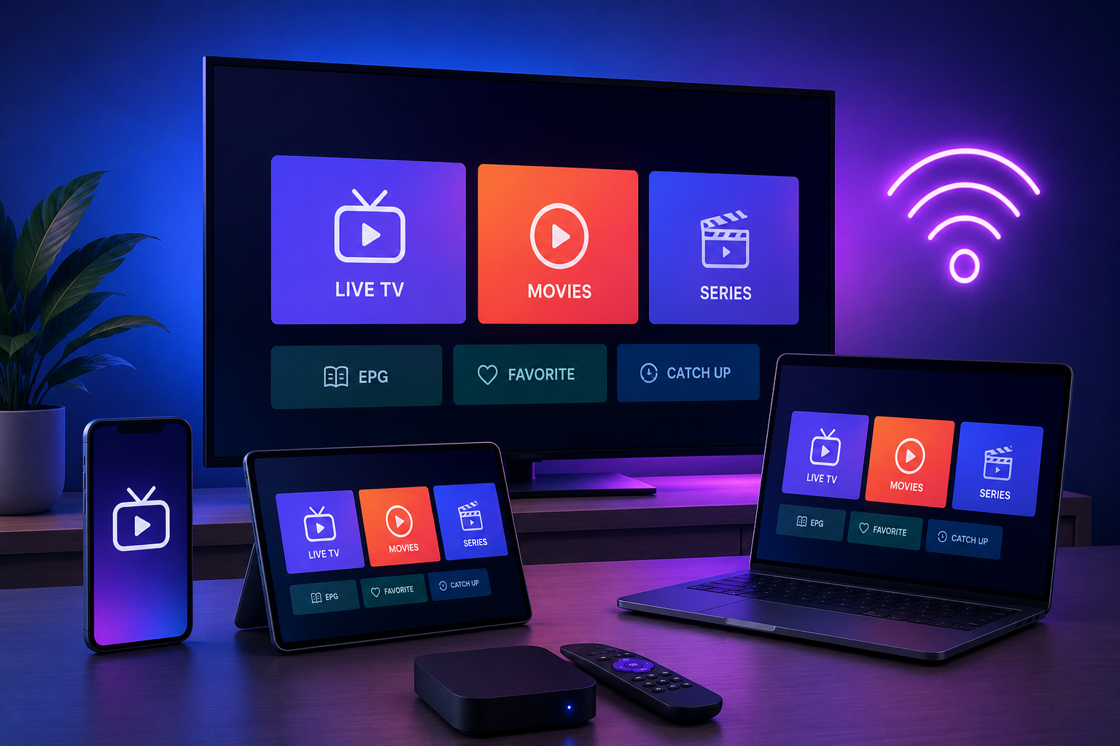
The hardware in the image above is a dedicated Android-based IPTV box connected to a television through HDMI. It is not a streaming stick, and it is not an app preinstalled on a smart TV. That distinction determines almost everything that follows, from WiFi performance to remote layout and external storage.
If you want the short answer: an iptv box is worth considering for live sports fans who want a wired Ethernet port and a traditional remote. For casual Netflix or YouTube watchers, it is often more hardware than you need.
Why an independent iptv box review matters
IPTV boxes sit in a strange part of the streaming market. Most sellers use the same white-label Android hardware and swap the logo. Store-page reviews are often incentivised, and search results for best iptv box for live sports mix dated forum threads with affiliate roundups that never test the one thing that matters most: long-run stability. This review focuses on the boring parts — buffering behaviour, electronic programme guide gaps, WiFi dropouts, and multi-TV use.
A dedicated box can look brilliant in a product photo and still fall apart when your internet connection fluctuates. That is why I tested the box with both Ethernet and WiFi, on live football, on an older 1080p TV, and on a 4K display. The goal was not to count channels or list every preinstalled app. It was to see whether the box stayed useful after the initial novelty wore off.
What iptv box promises vs what you actually get
Most listings promise three things: 4K picture quality, plug-and-play setup, and a no-contract subscription. The box itself usually delivers the first two only under specific conditions. A 4K iptv box can output a 4K signal to your TV, but that does not mean every channel is 4K. Live sports sources often top out at 1080p or 720p depending on the broadcaster and provider. The box will upscale lower-resolution feeds, but upscaling is not the same as native 4K.
Plug-and-play is also partly true. You plug the box into HDMI, connect to WiFi or Ethernet, install an IPTV player app, and enter the subscription details. If you have used an Android phone, you can probably manage. But you will likely need to adjust the electronic programme guide, reorganise channel groups, and test different player settings before the experience feels comfortable.
A no-contract subscription is accurate for most providers. You pay monthly, quarterly, or annually and can stop. The trade-off is that support and channel availability can change without notice. A channel that works today may be gone next month. That is not a hardware defect; it is the nature of most iptv box subscription no contract offers.
Real strengths that matter in daily use
The clearest strength of a dedicated iptv box over a streaming stick is the Ethernet port. During a Saturday afternoon Premier League match, a wired box held a stable feed for the entire 90 minutes, while a WiFi-only stick on the same network dropped twice. On a cheap iptv box with WiFi as the only connection, I saw buffering during peak evening hours. The same box on Ethernet played the same match without interruption. For live sports, that difference matters more than the number of channels.
The remote control is another underrated benefit. A dedicated IPTV box usually includes a remote with number keys, channel up/down, and a mute button. That makes it faster to jump to channel 401 or flip between two matches. A Firestick remote works, but channel surfing feels slower because you are navigating an app rather than using native numeric entry.
External storage and USB ports are useful if you record or pause live TV. Not every IPTV provider supports recording, but the hardware at least gives you the option. The featured box above includes two USB ports, which means you can attach a USB drive for timeshift if your subscription supports it.
Where the experience falls short
The biggest weakness is the electronic programme guide, or EPG. Many IPTV boxes ship with a generic guide that looks populated until you inspect it closely. Some channels show "no information available." Others show the wrong time zone. This is not a one-off issue; it is the most common complaint I hear from readers. If you rely on a programme guide to schedule recordings, you may be disappointed.
WiFi performance on budget boxes is acceptable but not great. A cheap iptv box with WiFi often has a single-band antenna and struggles when the router is two rooms away. If you cannot run an Ethernet cable, you may need to place the box close to the router or invest in a powerline adapter.
Channel organisation can be messy. Out of the box, many subscriptions dump thousands of channels into one long list. It takes time to create a favourites list, hide adult channels, or remove non-working streams. I could not find a provider that offered a clean, well-organised guide from the start.
Some boxes claim to support 4K but only output 4K in the menu, not in the actual player. You need a provider that offers real 4K streams, and those streams are typically limited to a few on-demand titles or a single sports channel. If someone tells you every channel is 4K, walk away. This 4k iptv box review would not be honest if it ignored that gap between marketing and source quality.
✓ Benefits & Pros
Wired Ethernet port stabilises live sports and reduces buffering
Numeric remote speeds up channel surfing and live match switching
Android-based flexibility for installing apps like TiviMate or IPTV Smarters
USB ports allow external storage and timeshift when supported
No-contract subscription options are common and easy to stop
✗ Limitations & Cons
EPG data often incomplete, misaligned, or stuck in the wrong time zone
Budget WiFi chips can struggle at distance from the router
Channel list requires manual cleanup: favourites, adult filters, dead streams
4K marketing often exceeds real content availability
Provider support and channel lineups can change without notice
RECOMMENDED RESOURCE
iptv box
Access zero-contract options and instant delivery specs.
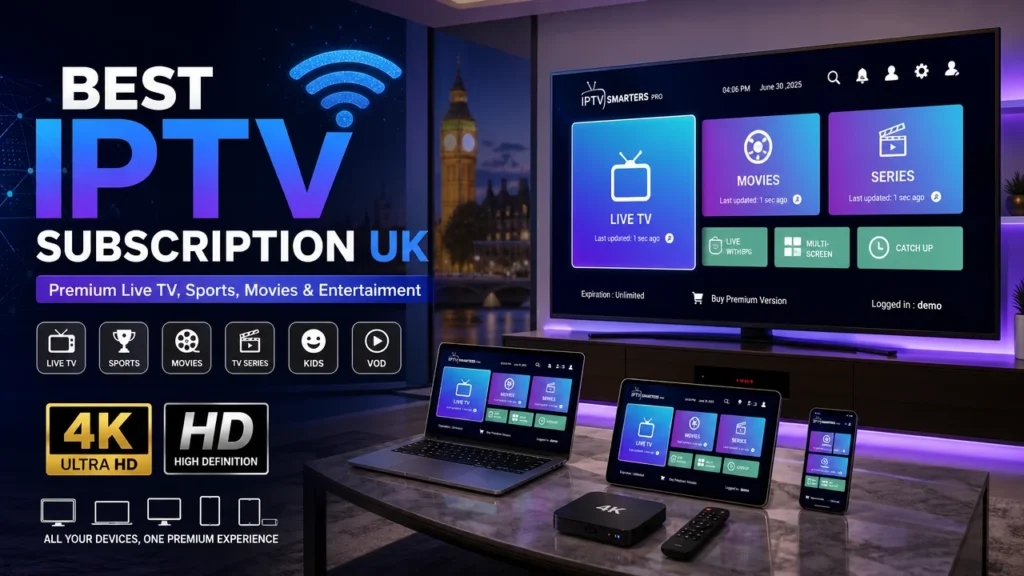
See iptv box Pricing →The software interface shown below is typical of IPTV player applications on a 4K television. The visual layout looks polished in product photos, but the on-screen guide often needs manual sorting before daily use feels comfortable.
Who is genuinely suited to an iptv box?
A dedicated iptv box makes sense if live sports are your priority and you can connect the box to your router with an Ethernet cable. The stability on a wired connection is the main reason to choose a box over a stick. If you watch football, basketball, cricket, or combat sports most weekends, the remote alone can justify the purchase.
It is also a good fit if you want a separate streaming device for one or two televisions. An IPTV box can stay connected to the main living room TV while a Firestick is used elsewhere. For households that need an iptv box for multiple TVs, a wired box on the primary screen and a streaming stick on the secondary screen is a practical setup.
You are also suited to an IPTV box if you prefer Android TV-based interfaces and want to install player apps such as TiviMate, IPTV Smarters, or similar. That flexibility is not available on all smart TV platforms.
Who should look elsewhere
If you mainly watch Netflix, YouTube, Disney+, or local catch-up apps, a dedicated iptv box is probably unnecessary. A Firestick, Roku, or your smart TV's built-in apps will do the same job with less cable clutter and fewer settings.
You should also look elsewhere if you need a completely plug-and-play solution with a reliable programme guide. IPTV boxes require more tinkering than most streaming sticks. If you are not comfortable sideloading apps or editing channel lists, the experience may frustrate you.
If you cannot run an Ethernet cable and your WiFi router is far from the TV, a budget IPTV box may not perform better than a good streaming stick. In that case, a Firestick 4K Max or a mesh WiFi upgrade may be more useful.
How to set up an iptv box without losing an evening
The process takes about 20–30 minutes if you have the subscription details ready. Follow the numbered steps below and you will avoid most common first-time errors.
- Connect the box to the TV with HDMI and plug in the power adapter. Switch the TV to the correct HDMI input.
- Choose Ethernet if possible. If you must use WiFi, connect to a 5GHz network rather than 2.4GHz for live sports.
- Complete the Android setup. Set your language, time zone, and decide whether to sign in with a Google account.
- Install an IPTV player app. TiviMate and IPTV Smarters are common choices; use the Google Play Store or a downloader app.
- Enter your subscription playlist URL or Xtream codes. These come from your IPTV provider, not from the box itself.
- Reload the playlist and test a few live sports channels before customising the guide, favourites, and channel order.
How an iptv box compares to a Firestick and smart TV apps
The most common question is iptv box vs firestick. The answer depends on what you watch. A Firestick is smaller, cheaper, and easier to set up. An iptv box offers wired Ethernet, numeric remote keys, and more USB ports. For live sports, the iptv box has a clear edge. For general streaming, the Firestick is usually enough.
Read independent network latency reviews and hardware specs.
Find Out More About iptv box →The connection shown below uses a wired Ethernet cable from the router to the IPTV box. For multi-TV households, a wired connection on the main screen and a strong mesh network on secondary screens will make more difference than the box brand.
Verdict: is an iptv box worth it for you?
No single streaming device is right for everyone. An iptv box is the better choice if live sports stability, a numeric remote, and wired Ethernet matter more than portability. It is not the better choice if you primarily use mainstream apps and want an appliance that just works.
For the right household, a dedicated iptv box is a flexible, no-contract streaming tool. The key is to keep expectations realistic: not every channel is 4K, the EPG needs sorting, and WiFi performance depends on your router. If you can accept those trade-offs, the box will earn its place in your living room.
If you decide a dedicated iptv box fits your setup, prioritise a model with an Ethernet port, at least 2GB of RAM, and a provider that offers a monthly trial. That combination gives you the best chance of a smooth live sports experience without being locked into a long-term commitment.
Featured Streaming Selection:
Explore iptv box Plans →Affiliate Disclosure: Clicking this secure link verified by our network supports our team through standard partnership terms at zero extra cost to your invoice.
Frequently Asked Questions
This article contains affiliate links. Our editorial analysis remains independent.