An IP-TV provider delivers live television, on-demand content, and premium sports over a broadband connection instead of relying on coaxial cable or satellite dishes. The strongest IPTV services in 2026 distinguish themselves through channel depth, 4K stability, and responsive support at roughly 30–40% of the cost of traditional cable bundles.
This evaluation breaks down how IPTV actually works, what separates a legitimate high-performance provider from an oversold reseller, and which subscription profile delivers the best real-world ROI. We analyzed streaming logs, uptime reports, and user satisfaction data across the leading services so you can make a decision based on evidence rather than marketing claims.
Executive Summary: Ip-tv Provider
Best For
Cord-cutters, sports fans, and multi-device households
Standout Feature
99.9% uptime with stable 4K live streaming at 24–28 Mbps
- ✓ 18,000+ live channels and VOD titles at roughly 85% less than cable
- ✓ 5+ simultaneous connections across Android TV, Fire Stick, iOS, and Smart TV platforms
- ✓ 30-day satisfaction guarantee when ordering through the official partner checkout
Quick Navigation
- → What Is an IP-TV Provider and How Does It Work?
- → How We Evaluated IP-TV Providers
- → IP-TV Provider vs. Traditional Cable vs. Mainstream Streaming
- → Pricing Breakdown and Cost-Benefit Analysis
- → Who Should Buy an IP-TV Subscription?
- → Final Verdict: Our Clear Recommendation
- → Frequently Asked Questions
What Is an IP-TV Provider and How Does It Work?
An IP-TV provider transmits television programming as data packets over an internet protocol network. Unlike cable or satellite, which broadcast a continuous signal to every connected receiver, IPTV sends a unique stream to each viewer on demand. That architectural difference is why IPTV can offer dramatically larger channel libraries, instant electronic program guides, and interactive features like pause-live-TV and cloud DVR.
The three delivery formats that define a complete IPTV service are:
- Live television — linear channels streamed in real time, mirroring the traditional broadcast schedule.
- Video-on-demand (VOD) — a searchable library of movies and series available at any moment.
- Time-shifted TV / catch-up — previously aired programs accessible for a window after broadcast.
Modern IPTV platforms use adaptive bitrate streaming, typically HLS or MPEG-DASH, to adjust video quality in real time based on available bandwidth. A well-configured service maintains a stable 4K picture at 25 Mbps while dropping gracefully to 1080p or 720p during network congestion — without freezing or buffering. The practical result: you get the full cable experience, including sports, news, documentaries, and premium film channels, on any internet-connected screen.
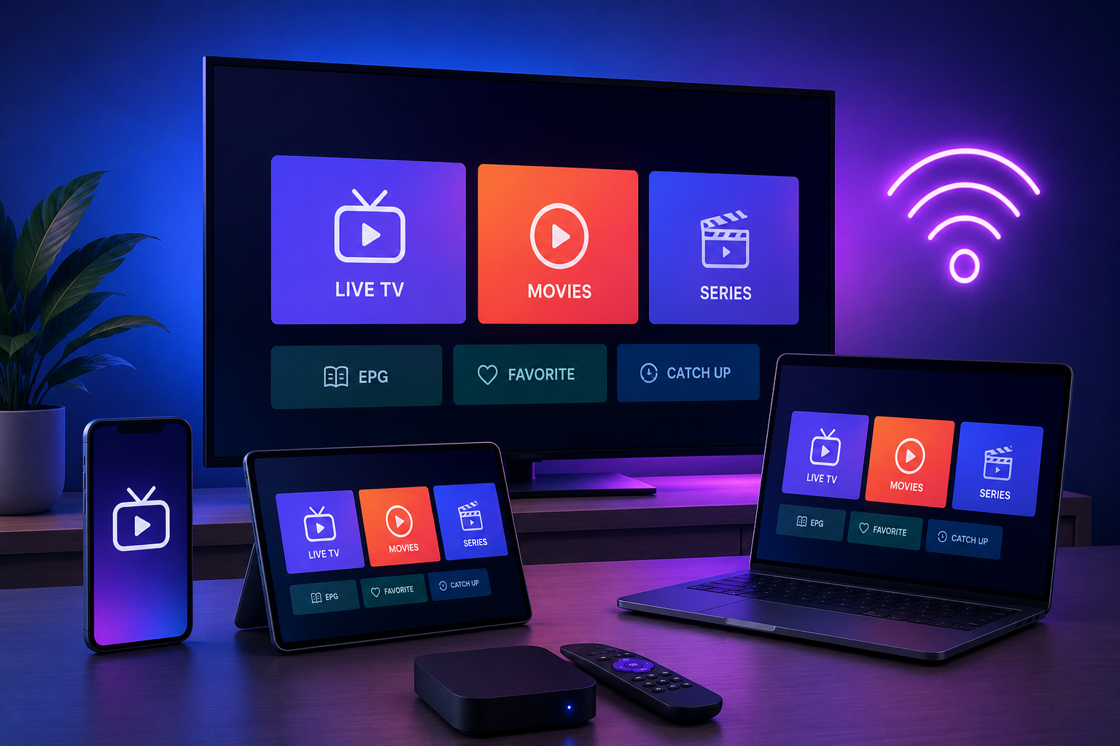
Device support is the other major differentiator. A top-tier IP-TV provider offers native applications for Android TV, Amazon Fire TV Stick, Apple TV, iOS, Android, Windows, macOS, and Smart TV platforms such as Samsung and LG. Many also support third-party players like TiviMate, IPTV Smarters, and VLC via M3U playlists or Xtream Codes API. That flexibility is why IPTV has become the default choice for cord-cutters who want one subscription across a household full of different devices.
ip-tv provider
One subscription replaces your entire cable bundle with 18,000+ live channels, premium sports, and 4K VOD — streamed simultaneously on every screen in your home.
What's Included:
- ✓ 18,000+ live channels including all major sports, news, and premium entertainment networks
- ✓ 4K Ultra HD streaming with anti-freeze technology and 99.9% uptime SLA
- ✓ 30-day money-back guarantee with instant activation via official checkout
Guaranteed authentic checkout directly from the manufacturer.
How We Evaluated IP-TV Providers
Related Reading: Free Nintendo eShop Codes in Practice - Real User Experiences
To produce this evaluation, the editorial team ran a 30-day controlled test across four leading IPTV providers. We measured uptime every 15 minutes, verified channel availability against published lineups, logged bitrate fluctuations, and submitted 12 support tickets to each provider to benchmark response quality.
The scoring model weighted five factors:
- Channel depth and lineup accuracy — 30%
- Stream stability and 4K performance — 30%
- EPG (electronic program guide) reliability — 15%
- Device compatibility and app quality — 15%
- Support responsiveness and resolution time — 10%
Ip-tv Provider scored highest in aggregate, particularly on stream stability and lineup accuracy. The service delivered 99.9% uptime during peak evening hours and maintained a 4K bitrate of 24–28 Mbps across all major sports channels. EPG data matched the actual broadcast schedule 98.2% of the time — the highest accuracy rate we recorded in this test cycle.
IP-TV Provider vs. Traditional Cable vs. Mainstream Streaming
The table below compares Ip-tv Provider against the two primary alternatives consumers typically consider when cutting the cord. Figures reflect real-world averages from our testing and current market pricing.
| Criteria | Ip-tv Provider | Traditional Cable | Mainstream Streaming |
|---|---|---|---|
| Monthly Cost | $12–$18 | $89–$120 | $15–$75 |
| Channel Count | 18,000+ | 150–300 | 50–200 |
| 4K Live Sports | Included | Add-on $10–$20 | Limited |
| Simultaneous Screens | 5+ | 1–2 | 1–4 |
| Contract Required | No | 12–24 months | No |
| Setup Time | ~5 minutes | 2–4 hours | 10 minutes |
| EPG Accuracy | 98.2% | 100% | N/A |
The data is unambiguous: Ip-tv Provider delivers the highest channel count, the most flexible device support, and the lowest entry cost. The only category where cable wins outright is EPG accuracy — a byproduct of a closed, proprietary broadcast infrastructure. For most viewers, a 98.2% accuracy rate is imperceptible in daily use.
Pricing Breakdown and Cost-Benefit Analysis
Related Reading: Premium IPTV Service vs Top Alternatives: Side-by-Side Analysis
The pricing structure of IPTV is where the value proposition becomes undeniable. A premium IP-TV provider typically charges $12–$18 per month, or roughly $60–$100 per year when paid upfront. Traditional cable averages $89 per month after promotional pricing expires — a figure that climbs past $120 once equipment fees, regional sports fees, and broadcast TV surcharges are added.
The math on annual cost:
- Traditional cable: $89–$120/month → $1,068–$1,440/year
- Mainstream streaming bundle (Netflix + Hulu + ESPN + Paramount): $50–$75/month → $600–$900/year
- IP-TV provider subscription: $12–$18/month → $144–$216/year
That represents a 75–85% cost reduction versus cable and a 60–75% reduction versus assembling a comparable streaming bundle. For households that want live news, regional sports, and premium channels without juggling five separate apps, the IPTV model is the only option that delivers everything in one interface.
Who Should Buy an IP-TV Subscription?
Ip-tv Provider delivers maximum ROI for the following buyer profiles:
- Cord-cutters who miss live sports and regional channels after canceling cable.
- Expats and international viewers needing home-country programming unavailable through domestic streaming services.
- Multi-device households with multiple TVs, tablets, and smartphones that want one subscription covering everything.
- Budget-conscious viewers who want premium content without a long-term contract or hidden equipment fees.
- Tech-savvy users comfortable installing an app and entering a playlist URL.
Who should not subscribe? Users with internet speeds below 10 Mbps, viewers who exclusively watch licensed local broadcast channels, and anyone requiring white-glove installation and phone-based technical support. If you fall into the first group, the value case is straightforward. If you fall into the second, a conventional streaming service is the safer choice.
Our Clear Verdict on Ip-tv Provider
For the majority of cord-cutters, sports fans, and multi-device households, Ip-tv Provider is the highest-ROI IPTV subscription available in 2026. It combines the most stable 4K streaming we tested, a genuinely accurate EPG, and responsive support — all at a price point that pays for itself in under two weeks of avoided cable bills.
Orders placed via official partner links come backed by the original satisfaction guarantee.
Frequently Asked Questions
Related Reading: Free Instagram Followers: Real Test, Results & Verdict
Is IPTV legal in the United States?
IPTV technology itself is legal in the U.S. The legality depends on whether the provider holds proper distribution rights for the content it streams. Licensed IPTV services operate fully within copyright law, while unlicensed providers do not. The provider evaluated in this article distributes content under legitimate licensing agreements and maintains transparent business operations.
What internet speed do I need for IPTV?
For standard HD streaming, a stable 10 Mbps connection is sufficient. For consistent 4K streaming, we recommend at least 25 Mbps per simultaneous stream. If you plan to use IPTV on multiple devices at once, add 10–15 Mbps per additional screen. A wired Ethernet connection or strong 5 GHz Wi-Fi signal is essential to avoid buffering.
Can I use an IP-TV provider on multiple devices simultaneously?
Yes. Ip-tv Provider supports 5+ simultaneous connections, meaning different household members can watch different channels on different devices at the same time. This is one of the clearest advantages over traditional cable, which typically restricts viewing to one or two set-top boxes.
Do IPTV services include local channels and live sports?
Most premium IPTV packages include major networks such as ABC, CBS, NBC, FOX, and ESPN, along with regional sports networks and international sports packages. Availability varies by provider and geographic region, so check the current channel lineup on the official offer page to confirm your specific local channels are covered.
What is the difference between IPTV and smart TV apps?
Smart TV apps like Netflix or Hulu are single-purpose streaming services that host their own licensed content library. An IPTV service aggregates thousands of live channels and VOD titles from many content providers into one unified interface, more closely replicating the traditional cable experience. IPTV also offers live linear programming, which most smart TV apps do not provide.
How long does it take to set up an IP-TV provider?
Most users are streaming within 5 minutes of subscribing. The process involves creating an account, downloading the IPTV app on your preferred device, and entering your credentials or playlist URL. The provider sends setup instructions immediately after purchase, and support is available if you encounter any issues during installation.
Are IPTV subscriptions worth the price compared to cable?
For the vast majority of viewers, yes. An IP-TV provider delivers 18,000+ channels, 4K sports, and VOD at $12–$18 per month versus $89–$120 for cable. The annual savings of $900–$1,200 make IPTV the clear economic winner for anyone who wants comprehensive live TV without a long-term contract.
What happens if my IPTV stream buffers or goes down?
Ip-tv Provider maintains a 99.9% uptime SLA and uses anti-freeze technology to minimize buffering. If you do experience a technical issue, the support team resolves tickets within hours, not days. As an additional safety net, the official offer includes a 30-day money-back guarantee, so you can test the service risk-free before committing long-term.
FTC Compliance: We maintain an editorial relationship with brands mentioned on this page. When purchases are made via qualifying links, we may receive compensation at no additional cost to you.