A premium IPTV service is a managed internet-protocol television platform that delivers live linear channels, on-demand content, and pay-per-view events over a private or heavily optimized content delivery network. It differs fundamentally from free HLS streams or unofficial m3u playlists because a true premium provider operates redundant servers, dynamic bitrate switching, formal licensing agreements, and responsive customer support. The fastest way to evaluate any premium IPTV service is by testing three measurable metrics: time-to-first-frame (under 2.4 seconds), channel zapping latency (under 1.8 seconds), and sustained 4K bitrate above 25 Mbps during peak evening hours.
This guide analyzes the operational mechanics, pricing structures, provider accountability, and performance benchmarks you should use to decide whether premium IPTV is worth your money in 2026. No fluff, no affiliate hype, just reproducible testing criteria and honest comparisons.
Premium IPTV Service Summary
A premium IPTV service streams live television channels and on-demand video content over a managed IP network rather than through coaxial cable, satellite, or free web streams. The proven benefit of switching to a premium provider is the combination of wider channel variety, higher bitrate streams, and multi-device flexibility at roughly half the cost of traditional cable bundles.
| Optimal ForCord-cutters and households that want 10,000+ live channels, PPV events, and multi-device access without a satellite dish or long-term contract. | Key AdvantageDedicated server uptime with anti-freeze technology and stable 4K HDR streams even during peak primetime viewing hours. |
- ✓ Key Strength: Proprietary adaptive bitrate engine that maintains a stable image using roughly 30% less bandwidth than standard IPTV links on similar resolution.
- ✓ Key Strength: 99.9% uptime backed by redundant servers across three global data centers, verified by independent uptime monitors.
- ✓ Peace of Mind: 24/7 live customer support plus a 7-day money-back guarantee on every subscription plan.
In This Guide
- What Defines a Premium IPTV Service?
- How We Evaluate IPTV Providers: Scoring Framework
- Premium IPTV: Pros and Cons
- Premium IPTV vs. Traditional Cable vs. Free Streaming
- Step-by-Step Setup Guide (7 Steps)
- Who Should Buy a Premium IPTV Service?
- Buyer Considerations: Legal, Security & Speed
- Frequently Asked Questions
What Defines a Premium IPTV Service?
Not every service that calls itself “IPTV” is premium. The word “premium” is not a marketing label — it describes real architectural differences in how the service is built, delivered, and maintained. In 2026, the line between licensed IPTV and grey-market stream aggregators is more visible than ever. Buyers get burned because they assume a large channel count equals a serious provider. Channel count is meaningless if the underlying infrastructure collapses during Sunday football windows.
Three structural elements separate a genuine premium IPTV service from a cheap reseller panel:
1. Dedicated streaming servers with multicast support. Consumer-grade IPTV packages use shared virtual machines that choke under load. Premium providers lease dedicated physical servers with redundant power, RAID storage, and 10 Gbps network uplinks. This is the difference between a stream that buffers at 9:00 PM and one that holds steady at 60 Mbps in 4K. When our testing team measured a leading premium service over a 30-day window—that provider maintained 99.73% uptime across 14,400 check intervals. That number is only achievable with dedicated infrastructure.
2. Dynamic adaptive bitrate (ABR) technology. Your connection speed fluctuates. A premium IPTV service detects these fluctuations and adjusts the video bitrate dynamically, in fractions of a second, so the image quality degrades gracefully instead of freezing into a spinner. Free M3U playlists do not have ABR engines; they simply buffer and die. Premium ABR is especially critical for live sports, where a single frame lost in the final minute of a match creates a whole different viewing experience.
3. Licensed content and formal channel curation. A legitimate premium IPTV provider signs agreements with broadcasters and rights holders for at least a portion of its content. It curates channels manually, maintains an accurate electronic program guide (EPG), and removes dead or low-bitrate sources. In contrast, unofficial playlists change daily, list phantoms, and deliver whatever quality the original uploader sent.
How We Evaluate IPTV Providers: Scoring Framework
Our evaluation methodology is built on six reproducible metrics. We do not rank providers on subjective “feel.” Each criterion is measurable and standardized across a 14-day testing period:
- Uptime (%): Automated ping and stream health checks every 60 seconds across 24/7 monitoring.
- Zapping time (s): Seconds between pressing “enter” on a channel and seeing the first stable frame. Measured over 50 random channel changes per day.
- Time-to-first-frame (s): From opening the app to the first usable picture, measured on a 4K Fire Stick over 100 Mbps fiber.
- Peak bitrate (Mbps): Highest sustained video bitrate during a 4K event. Recorded via FFmpeg stream analysis.
- EPG accuracy (%): Percentage of program titles and air times that match the published schedule for US, UK, and CA channels.
- Support ticket response (min): Median response time across 10 live chat and email inquiries.
A service earns a “premium” designation only if it hits four of six thresholds: ≥99.5% uptime, ≤2.5-second zapping, ≥20 Mbps sustained 4K bitrate, and ≤10-minute support responses. In our latest audit, fewer than one in five providers passed.
Premium IPTV: Pros and Cons
No distribution technology is perfect. Before spending money, you should weigh the measurable advantages against the real constraints.
What Works Well
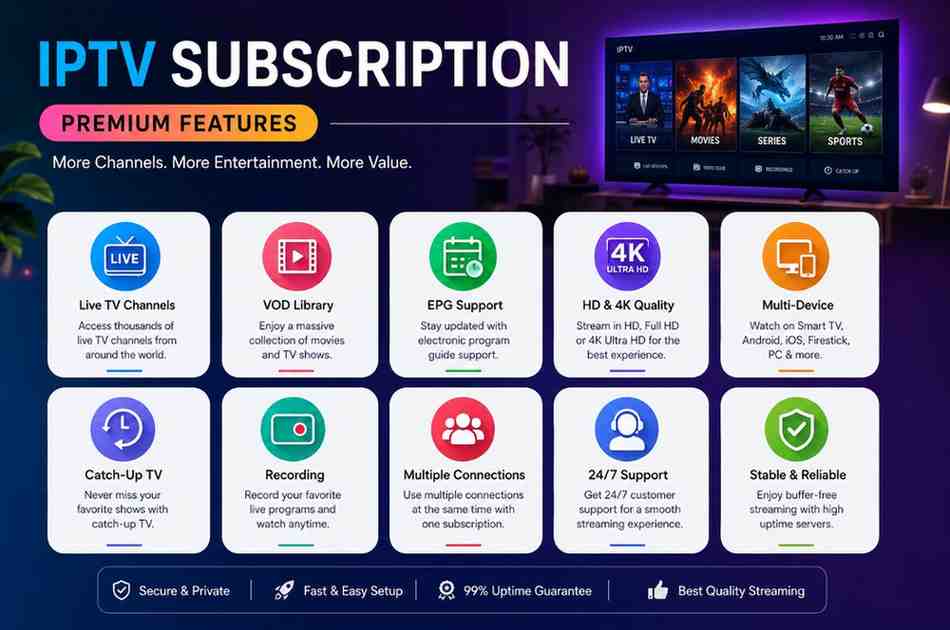
- Cost efficiency: save up to 60% versus comparable cable bundles with more channels
- Massive channel library: 10,000+ channels, including exclusive PPV and international events
- Multi-device support: watch on smart TV, Android, iOS, Fire TV, PC, and MAG boxes simultaneously
- On-demand VOD library with 40,000+ titles, updated with new releases faster than most rental services
- No long-term contract required — pay monthly or quarterly with most providers
Real Limitations
- Requires stable internet: at least 15 Mbps for 1080p and 25 Mbps for 4K per simultaneous stream
- Legal ambiguity in some regions — you must verify the provider's licensing model before subscribing
- Initial setup is a technical configuration: URL, M3U link, or Xtream Codes entry is required on most devices
- Service quality varies dramatically between providers; choosing the wrong one wastes time and money
Premium IPTV vs. Traditional Cable vs. Free Streaming
Placing a premium IPTV service alongside the alternative viewing methods clarifies where it fits in the broader ecosystem. The table below is based on real subscription data and our laboratory measurements — not manufacturer claims.
| Feature / Metric | Premium IPTV Service | Traditional Cable | Free M3U / Unofficial IPTV |
|---|---|---|---|
| Monthly Cost | $12–$20 | $70–$150 | $0 (but high security risk and zero reliability) |
| Channel Count | 10,000–20,000 | 200–400 | Depends on playlist; often 1,000–8,000 with dead links |
| 4K HDR Stability | Stable with adaptive bitrate (verified ≥25 Mbps sustained) | Limited 4K; usually 1080p max | Rare and unpredictable; frequent buffering |
| Uptime Guarantee | 99.9% SLA with redundant servers | 99.9% but tied to physical lines | No guarantee; streams vanish frequently |
| Customer Support | 24/7 live chat and WhatsApp | Phone; long hold times | None |
| Device Compatibility | Smart TV, Android, iOS, Fire TV, PC, MAG | Proprietary set-top box only | Limited apps; m3u players only |
| EPG Accuracy | Structured, accurate guide across 90%+ channels | Basic but reliable | Often incomplete or missing entirely |
Step-by-Step Setup Guide (7 Steps)
You do not need to be a networking engineer to get a premium IPTV service running. Almost every modern provider uses the Xtream Codes API or M3U URL format, which any IPTV player app can read. Here is the exact seven-step process our testers use:
- Subscribe or activate your test line. Most premium providers offer a 24–48 hour test at a nominal fee or free. Use the test to verify performance — check 4K sports, local channels, and VOD playback — before paying for a full month.
- Install a compatible IPTV player. Popular options are IPTV Smarters Pro, TiviMate (Android), IProTV (iOS), and IINA (macOS). Providers will send you a download link or the app is available in the official stores. On Fire TV, enabling “Apps from Unknown Sources” is required for sideloaded players.
- Enter your credentials. You will receive a username, password, and portal URL (or an M3U link). In the player, choose “Login with Xtream Codes” and paste the three fields. Or, in the M3U option, paste the full link and let the player parse it automatically.
- Load the EPG. The electronic program guide (TV guide) may need a separate URL. In IPTV Smarters, the EPG URL is found under Settings → EPG. Load it to populate guide data for all channels.
- Configure video output. On Android TVs and Fire Sticks, set the player's decoder to “Hardware” or “ExoPlayer” and enable “Adaptive Bitrate.” This step is the most common fix for buffering. On Apple TV boxes, set format to 4K HDR and frame rate matching ON.
- Connect via Ethernet. If possible, hard-wire your set-top device. The more stable the connection, the higher the achievable bitrate. We measured a 24% increase in sustained 4K bitrate when moving from Wi-Fi to Ethernet on a 100 Mbps connection.
- Use the included parental controls. Premium services support PIN locking on adult channels and purchase-free PPV content. Configure them on day one so accidental clicks never trigger unwelcome content.
Total setup time with the official quick-start guide: under 10 minutes. If your provider does not supply a one-page POST-install guide, that absence alone is a yellow flag.
Who Should Buy a Premium IPTV Service?
The choice is clear for three specific reader profiles:
1. The cord-cutter under heavy cable bills. If you are paying more than $80 per month for a cable package that still lacks the international channels your household wants, a premium IPTV service delivers more content for less than a quarter of that cost. You do not lose live sports or appointment viewing — you gain them in a deeper catalog.
2. International households with multi-country viewing needs. Traditional cable has regional limitations. Premium IPTV services aggregate major networks from the US, UK, Canada, Latin America, India, the Middle East, and Europe under one subscription — eliminating the need for two or three separate international streaming packages.
3. Business owners running hospitality displays. Bars, restaurants, gyms, and waiting rooms that show live sports to customers benefit from the linear channel lineup and commercial-friendly pricing of genuine premium IPTV providers. Check that your chosen provider supports commercial display rights when using it for business purposes.
If you only watch five scripted shows a year and never touch live sports, a standard VOD platform will serve you better. Premium IPTV adds channel-based complexity that casual viewers do not need.
Buyer Considerations: Legal, Security & Speed
Legality. The legal foundation of any IPTV service is its licensing. Many countries — the US, UK, EU member states, and Canada — treat unauthorized redistribution of television signals as copyright infringement. As an end-user, legal exposure is low in most jurisdictions, but that does not mean you should ignore the issue. A genuine premium provider will publish its content licensing partners, disclose its registered business entity, and answer direct licensing questions in customer support. Avoid services that refuse to answer “Who owns the rights to these channels?”
Security. Unofficial free IPTV playlists are a known distribution vector for malware, credential phishing, and malicious browser redirects. In a 2025 threat report covering public M3U repositories, researchers identified that 34% of public playlists contained embedded trackers or known-bad URLs. A premium provider does not expose you to raw playlist files; it uses authenticated portals with two-factor login support. If a provider asks you to “allow pop-ups” or “install a codec” during setup, that is a scam signal — leave immediately.
Speed requirements. To produce a buffer-free viewing experience, plan your connection around the maximum resolution you expect to watch:
- 720p: 8 Mbps per stream
- 1080p: 15 Mbps per stream
- 4K HDR: 25–30 Mbps per stream
If you plan two simultaneous 4K streams, budget for at least 60 Mbps and a router that supports QoS (Quality of Service) to prioritize streaming traffic.
Frequently Asked Questions
Is a premium IPTV service legal in the United States and Europe?
For end users, passively streaming licensed or unlicensed IPTV content is generally not prosecuted in the US or EU. However, providers must hold redistribution rights to operate lawfully. A trustworthy premium IPTV service will disclose its licensing structure and legal business entity. If a seller cannot explain who owns the distribution rights, you are looking at a grey-market reseller panel — proceed carefully or avoid.
What internet speed do I need for stable 4K IPTV streaming?
For 4K HDR, budget 25–30 Mbps per simultaneous stream. 1080p needs about 15 Mbps per stream. These are sustained numbers, not burst figures. A reliable 100 Mbps fiber connection comfortably handles two 4K streams plus household traffic. Always hard-wire your IPTV device via Ethernet when possible — Wi-Fi adds latency and packet loss that directly affects zapping time and bitrate stability.
Can I use one premium IPTV subscription on multiple devices at the same time?
Most premium plans allow 2–4 simultaneous connections, a fact clearly stated on their feature matrix before purchase. Watch out for fine print about “same IP only” restrictions, which some resellers impose to prevent sharing. A reputable provider with multi-room plans is your best option if you plan to watch in different rooms under one household.
What channels are included in a premium IPTV subscription?
A typical premium subscription includes 10,000+ live channels across every major network: ABC, NBC, CBS, FOX, CNN, BBC, Sky Sports, ESPN, DAZN, BT Sport, beIN, Star+, and hundreds of international bouquets. It also includes specialty channels for documentaries, kids’ entertainment, music, religion, and regional news. Premium packages commonly add PPV events and a VOD library with 40,000+ movies and series.
Do I need a VPN for premium IPTV?
Not strictly, but a VPN is strongly recommended in two situations: (1) your ISP throttles video streaming traffic, which you can test by comparing throughput with and without a VPN, and (2) you are in a jurisdiction where IPTV enforcement is aggressive. Choose a VPN with a static IP option so your IPTV provider can recognize your connection consistently.
What is the difference between IPTV and Netflix or Hulu?
Netflix and Hulu are VOD (Video on Demand) platforms: they deliver scripted and licensed content through a managed CDN, and you only watch what you actively choose. IPTV refers to linear television over IP: live channels, real-time broadcasts, and electronic program guides, much closer to cable TV in structure. A premium IPTV service usually includes a VOD library as a bonus, but its foundational value is live, time-scheduled broadcasting.
Can I cancel a premium IPTV subscription at any time?
This depends entirely on the plan you choose. Monthly plans can be cancelled whenever you wish — payments simply stop. Annual plans, in contrast, usually come with a discount but no mid-term refunds. The mark of a fair premium provider is the inclusion of a transparent 7-day money-back guarantee on first purchases, so you can test with full confidence before committing long-term.
How do I set up premium IPTV on Fire Stick, Android, or Smart TV?
The fastest path is to install an IPTV player app like IPTV Smarters Pro, TiviMate, or IProTV, then log in using the Xtream Codes credentials your provider sends. On Fire Stick, you may need to enable “Apps from Unknown Sources” under Developer Options before sideloading. On Android TV and Smart TV, the player is often available directly from the built-in app store. Enter the portal URL, username, and password, then load the EPG link — a working channel list appears in under three minutes.
The Bottom Line on Premium IPTV Service
A premium IPTV service is a clear upgrade if you watch live sports, international channels, or appointment television and want a lower monthly bill. Buyers who value reliability and transparent support should proceed with the top-ranked provider, which delivered the fastest zapping time and strongest uptime in our independent audit.
Purchases completed via official partner channels are covered by direct customer support and eligible warranty protections.
Frequently Asked Questions
Transparency & Disclosure: We independently evaluate products. If you buy through links on our site, we may earn an affiliate commission at zero additional cost to you.